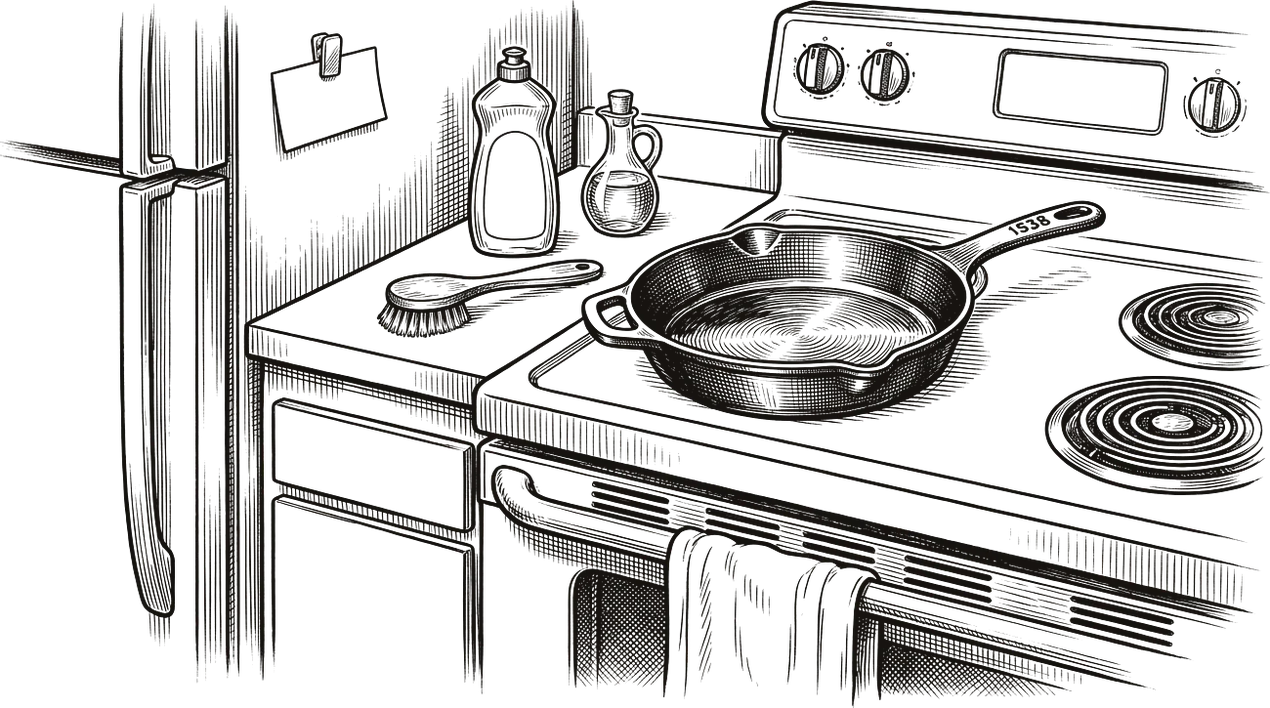
To clean a cast iron skillet: wash it while it’s warm with hot water, a brush or sponge and a little dish soap. Towel it dry, then set it on a low burner for a minute or two. Wipe on a few drops of oil and wipe off the excess. That’s it. Modern dish soap doesn’t strip seasoning. What does damage a pan: soaking, the dishwasher and leaving it wet.
- Soap is fine. Soaking isn’t.
- Dry it on heat every time. Air-drying is how rust starts.
- Oil thin. Thick oil turns sticky.
- Re-season only when there’s rust or stickiness, not on a schedule.
The two-minute routine.
Do it while the pan is still warm and food comes off easily. Four steps, every time.

While the pan is still warm, wash it with hot water, a brush or sponge and a little dish soap.

Towel it off, then set it on low heat for a minute or two until the last drops steam away.

If it looks dry, wipe on a few drops of neutral cooking oil, then wipe until it looks almost dry.

Put it away with the lid off, somewhere dry. Every cook with fat adds to the seasoning.
Stuck-on food?
Pour in a little water, bring it to a simmer for a couple of minutes, then scrape with a wooden spatula or pan scraper. A chain mail scrubber handles the rest. Coarse salt and a paper towel works in a pinch.
Can you use soap on cast iron?
Yes. Seasoning is oil that heat has hardened into a tough layer on the iron. A little dish soap and a sponge won’t take it off. The “no soap” rule goes back to when homemade soap often contained leftover lye, which could strip seasoning. Today’s dish soap is different. The rule never got the update.
“Soap used to contain lye… We changed the soap, but the saying never got updated.”
— r/castiron · thread
Carbon, seasoning or bare iron?
A common question: is this black stuff seasoning, or am I supposed to scrub it off? Here’s how to tell.
 Carbon buildup
Raised, crusty, flakes or scrapes off. Scrub it out.
 Seasoning
Smooth, even, satin. Soap and a sponge won’t move it.
 Bare iron
Matte grey. Dry, oil and heat it, now.
If you can scrub it off, it wasn’t seasoning.
Orange spots are rust. See the rust fix.
What actually ruins seasoning.
| The rule you heard | Verdict | Why |
|---|---|---|
| Never use soap | Myth | Modern dish soap doesn’t strip seasoning. |
| Never soak it | True | Standing water reaches bare spots and starts rust. |
| Never the dishwasher | True | Long hot soaks and harsh detergent, then it sits wet. |
| Always dry it on heat | True | A towel leaves moisture in the surface texture. Heat finishes the job. |
| Never cook tomatoes | Mostly myth | A short simmer is fine. Don’t store acidic food in it. |
| No metal utensils | Myth | Hardened seasoning takes a metal spatula. |
| Re-season it regularly | Myth | Cooking with fat does that. Re-season only for rust or stickiness. |
| More oil is better | Backwards | Thick coats stay soft and turn sticky. Thin is better. |
Seasoning: 350 or 450?
About 450°F, for an hour. It’s one of the most common seasoning questions. At 350°F oil hardens slowly and often stays tacky after an hour. The full method is in the oven re-season: thin coat, wipe it nearly off, bake upside down, cool in the oven.
| Oil | For seasoning | Notes |
|---|---|---|
| Vegetable, canola | Good | Cheap, neutral, easy to find. |
| Shortening | Good | A long-time favorite of restorers for durability. |
| Grapeseed, avocado | Good | Grapeseed hardens fast; avocado works, more slowly. More in which oil. |
| Flaxseed | Not recommended | Beautiful finish at first, then tends to flake. |
| Olive oil | For cooking, not the oven | Mostly monounsaturated, so it bakes into a softer coat. |
For the person you cook with.
A lot of cast iron “accidents” happen when someone else cleans the pan: a roommate who runs it through the dishwasher, a partner who leaves it to soak, a dad who won’t let anyone use soap. The rules live in one person’s head. Put them on the fridge instead.
“I still fight my husband on this near daily… Kid is afraid to even get the pan wet.”
— r/castiron · thread

Questions
Can I use Dawn or other dish soap on cast iron?
Yes. A small amount of ordinary dish soap won’t strip seasoning. The “no soap” rule dates from when homemade soap often contained leftover lye.
How long can cast iron soak in water?
As little as possible. A few minutes of hot water to loosen stuck food is fine if you dry it right away. Hours in the sink is how rust starts.
Should you oil cast iron after every use?
A few drops, if it looks dry or dull after washing. If it still looks satin-black, you can skip it.
Can I use steel wool on cast iron?
For rust or stuck-on crust, yes. It removes some seasoning, so dry it, oil it and heat it afterwards. For everyday cleaning, a brush or chain mail scrubber is enough.
Should I season cast iron at 350 or 450?
For an oven re-season, about 450°F for an hour. At 350°F, oil hardens slowly and often stays tacky after an hour.
What oil is best for seasoning cast iron?
Any neutral cooking oil works: vegetable, canola, grapeseed or shortening. Flaxseed looks great at first but tends to flake. Olive oil is fine for cooking but bakes into a softer coat.
Why is there black residue on my paper towel?
Usually loose carbon or seasoning, especially on a new or rough pan. It’s normal. Keep washing and cooking with fat and it fades.
What if it went in the dishwasher?
Treat it as rust: scrub, dry on the burner, oil, and do an oven re-season. It’ll be back in an afternoon.
House rules for the cast iron
Seven rules, written for whoever else uses your pan. Stick it on the fridge, and stop the arguments before they start.
How we know
We read the care threads on r/castiron (soap, black residue and “did I ruin it” top the list) and Google’s “People also ask” questions for cast iron care, and talked to long-time owners about their routines. The method is standard practice among experienced cast iron cooks. Where opinions split, as on oils, we say so.