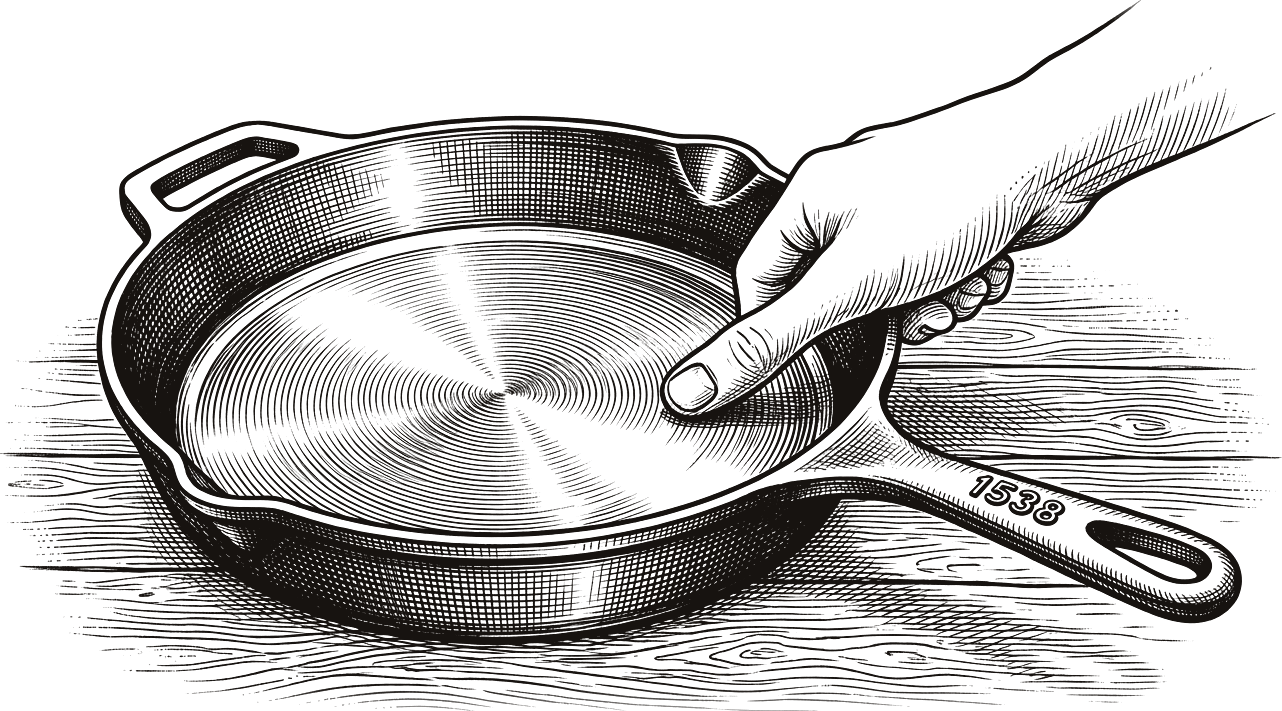
A cast iron pan is only finished if it’s cracked. Rust, flaking, sticky spots, patchy color and even a slight warp can be fixed or lived with, most in under an hour with things you already own. Find your symptom below.
Find your symptom.
 Food sticking
 10-min fix
Rust
- Looks like
- Orange or reddish spots, a rusty haze, sometimes a dusty orange film on a towel.
- Why
- Water left on the iron: air-drying, soaking, or storing it somewhere damp.
- The fix
- Scrub the rust off with steel wool or a stiff brush, warm water and a little soap.
- Rinse, towel dry, then set it on low heat for a few minutes until bone dry.
- Wipe on a few drops of oil, then wipe until it looks almost dry.
- Heat until it stops smoking. Lots of spots? Use the oven re-season below.
- Next time
- Dry it on the burner every time, and store it somewhere dry with the lid off. Shallow pitting is cosmetic. Deep pits can hold food and take longer to season over, but the pan still cooks.
One owner lost his wife’s grandmother’s pan, not to cooking but to a damp storage room. Store it dry.
 10-min fix
Black flakes
- Looks like
- Small black chips in your food, or patches lifting off the cooking surface.
- Why
- Usually carbon: burnt-on food and old oil that never got fully cleaned off. Sometimes thick seasoning coats that didn’t bond lift away.
- The fix
- Wash with soap and a stiff brush or chain mail scrubber until nothing more comes off.
- Dry on the burner.
- Wipe on a thin coat of oil and heat until it stops smoking.
- If it keeps flaking in sheets, re-season (below).
- Next time
- Clean it fully after each cook. Soap is fine, and it won’t strip real seasoning.
 1-hour fix
Sticky or tacky
- Looks like
- The surface feels gummy, holds fingerprints, or looks blotchy and glossy with drips.
- Why
- Too much oil left on the pan. A thick layer doesn’t fully harden; it turns gummy instead.
- The fix
- Put the pan upside down in a 450°F oven for an hour (foil on the rack below).
- Or heat it empty on the stove until it stops smoking.
- If it’s badly gummy, scrub with hot soapy water first.
- Next time
- After oiling, wipe it like you’re trying to remove all the oil. What’s left is plenty.
 Fine
Patchy color
- Looks like
- Some areas are deep black, others brown or bronze. Uneven, especially on a newer pan.
- Why
- Seasoning builds unevenly at first: where you cook most, it gets darker sooner.
- The fix
- Nothing to fix. Keep cooking with fat.
- Fatty foods (bacon, potatoes, sear-and-roast) even it out fastest.
- Next time
- This is what a pan in use looks like.
 Live with it
Wobbles or spins
- Looks like
- The pan rocks on a flat cooktop or spins around a raised spot.
- Why
- Warping, usually from uneven heating: high heat on a small burner or induction zone, or a cold pan blasted on high. Cold water on a hot pan can warp it, or crack it.
- The fix
- Check it: lay a ruler across the bottom, or set it on a flat counter and press each edge.
- A slight warp still cooks fine on gas, on a grill or in the oven.
- On glass-top or induction a pan that rocks heats poorly and can slide, so keep it for gas, grill or oven.
- Don’t try to hammer it flat. That’s how warped pans crack.
- Next time
- Heat gradually, never plunge a hot pan into water, and match the burner to the pan.
 Retired
Crack
- Looks like
- A sharp, dark line, often with jagged edges, that may show on the underside too.
- Why
- Thermal shock or a hard drop. Iron is strong but brittle.
- The fix
- Stop cooking on it: cracks spread under heat and can fail.
- Hang it on the wall. It earned it.
- Next time
- This is the one real ending. Everything else on this page is fixable.
 Fine
A raised line or bump
- Looks like
- A smooth-edged ridge or wavy line that doesn’t go anywhere.
- Why
- A casting mark from the mold, not damage.
- The fix
- Nothing to do. Unlike a crack, it’s raised and rounded, and it doesn’t change over time.
The oven re-season.
For widespread rust, sticky patches, or after a deep scrub. Most of the time is hands-off.
| Step | What to do | Time |
|---|---|---|
| 1 · Scrub | Steel wool, warm soapy water. Get rust and gunk off. | 5 min |
| 2 · Dry | Towel, then low heat until completely dry. | 3 min |
| 3 · Oil | A teaspoon of oil rubbed over every surface: inside, outside, handle. | 2 min |
| 4 · Wipe off | Buff with a clean cloth until it looks almost dry. Thick oil turns sticky. | 2 min |
| 5 · Bake | Upside down, 450°F, 1 hour. Foil on the rack below. | 1 hr |
| 6 · Cool | Turn the oven off; let it cool inside. Repeat once or twice for a deeper finish. | 30 min |
Scrub, strip, or keep cooking?
Most of the internet jumps straight to stripping a pan to bare metal. You almost never need to.
| Keep cooking | Scrub (10 min) | Re-season (afternoon) | Strip (weekend) | |
|---|---|---|---|---|
| Patchy color | ✓ | |||
| A few rust spots | ✓ | |||
| Rust all over | ✓ | ✓ | ||
| Flakes / carbon | ✓ | If it persists | ||
| Sticky | ✓ | |||
| Thick crusted buildup, thrifted pan | ✓ |
“If you didn’t crack or warp it, it’s fixable.”
— r/castiron · thread
Questions
Did dish soap ruin my seasoning?
No. Seasoning is oil baked into a hard layer stuck fast to the iron. Modern dish soap doesn’t strip it. Soaking for hours can lead to rust, but a wash won’t.
Someone put it in the dishwasher. Now what?
It’ll probably come out dull and rusty. Treat it as rust: scrub, dry on the burner, oil, then do the oven re-season. It will be back in an afternoon.
How do I tell a crack from a casting mark?
A crack is a sharp, dark, often jagged line that can show on both sides. A casting mark is raised, smooth-edged and stays the same over time. If in doubt, check the underside directly below the line.
Is it safe to cook with a little rust left?
A little leftover rust isn’t harmful, but scrub off what you can see and re-oil before cooking. Faint discoloration fades as the seasoning builds.
Can a warped pan be fixed?
Not reliably. Trying to hammer it flat can crack it. A slightly warped pan still cooks fine on gas, on a grill or in the oven.

The rescue flowchart
Every symptom on this page, as a one-page flowchart to keep in a drawer. Comes with the care sheet.
How we know
The symptoms are the ones people actually post about: “Did I ruin it?” is a fixture of r/castiron, and we read 824 threads plus 445 Amazon reviews to rank them. The fixes are standard practice among long-time cast iron cooks. Where opinions split (stripping methods, for one), we’ve said so.