
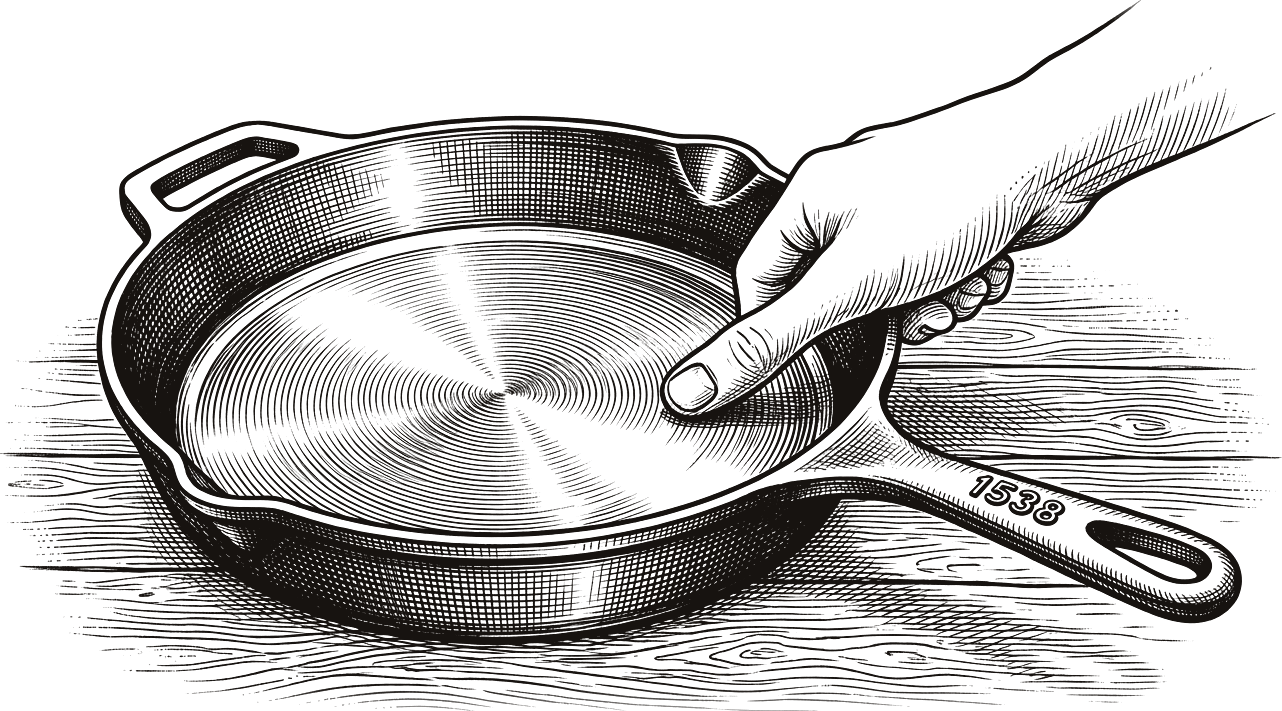
A smoother cooking surface mainly changes how easily the pan cleans: food and grease have less to grab, and towels don’t shred on it. It helps release a little, but heat, fat and timing matter far more. Seasoning grips iron well, so smooth pans hold it fine, though a mirror polish makes the first coats slow to build. The sweet spot is machined or ground smooth, not polished to a mirror.
Five things people mix up.
Most arguments about smooth cast iron are really about five different things. Split them apart and the debate mostly settles itself.
“cooking seems to be about the same … Cleaning, on the other hand, is day and night.”
— r/castiron, on a thread about a sanded pan with 15,000+ upvotes · thread
What’s going on at the surface.
Seasoning is cooking oil that heat has turned into a hard, plastic-like layer stuck fast to the iron. On a rough surface it pools in the low spots, builds up thick and uneven, and gives burnt bits somewhere to hide. On a mirror-polished surface the first thin coats have little to hold onto, which is where the “smooth pans won’t hold seasoning” reputation comes from. A machined or ground surface sits between the two.


Sand-cast texture snags paper towel fibers and holds onto carbon. Machining leaves fine tool lines: smooth to the touch, with enough texture for seasoning to take hold.
Why old pans were smooth and new ones aren’t.
Pick up a well-kept pan from the early 1900s and run your thumb across it: it’s often noticeably smooth. Many American foundries of that era ground or machined the cooking surface after casting. Over the following decades most mass-market makers dropped the step. It’s slow and expensive, and a sand-cast surface with factory seasoning on top is cheaper to make.
A former foundry operations lead we interviewed put it plainly: the grinding step was dropped as a niche, costly process, not because it cooked worse.
That’s why people hunt antique stores for old pans, and why “why don’t they make them like this anymore?” is one of the most-asked questions in cast iron.
Can’t I just sand one?

You can, and thousands of people have. Done well, it works. Here’s what the before-and-after photos leave out:
- Time. Expect a few hours with an orbital sander or an angle grinder with flap discs.
- Dust. Iron dust needs a respirator and eye protection, and it gets everywhere.
- Flatness. Keeping the cooking surface flat by hand is the hard part. Dips and waves are common.
- Starting over. You grind off the factory seasoning and build it again from bare iron.
Many people who sand their own stop somewhere between 80 and 220 grit. Go much finer and you’re heading toward the mirror problem.
“this is not worth it for new iron, and you should just buy a pan with the finish you want.”
— r/castiron · thread
Which should you buy?
Questions
Will a smooth pan lose its seasoning?
Not if you build it the normal way: thin coats and cooking with fat. Problems usually come from thick oil layers on a very polished surface, which peel instead of bonding.
Does a rough pan get smoother over time?
Yes, slowly. Years of cooking, scrubbing and metal spatulas wear down the high points and fill the low ones.
Is smooth cast iron the same as carbon steel?
No. Carbon steel pans are made from rolled sheet, so they’re naturally smooth, thinner and lighter. They heat faster and hold less heat than cast iron.
Is a smooth pan more nonstick?
A little, especially with eggs. But a rough pan used well will out-release a smooth pan used badly. Heat, fat and timing come first.
What grit do people sand to?
Many people who sand their own pans stop somewhere between 80 and 220 grit. Very fine finishes slow the first coats of seasoning.

The care sheet
Wash, dry, oil: the two-minute routine that keeps any surface, rough or smooth, in shape. One page, made for the fridge.
How we know
Smooth vs rough drew the most debate in our October 2026 read of cast iron forums: about 190 threads and 690 comments. Only cleanup had near-universal agreement. We also interviewed a former foundry operations lead and owners of both smooth and rough pans. Our own side-by-side test is planned.


