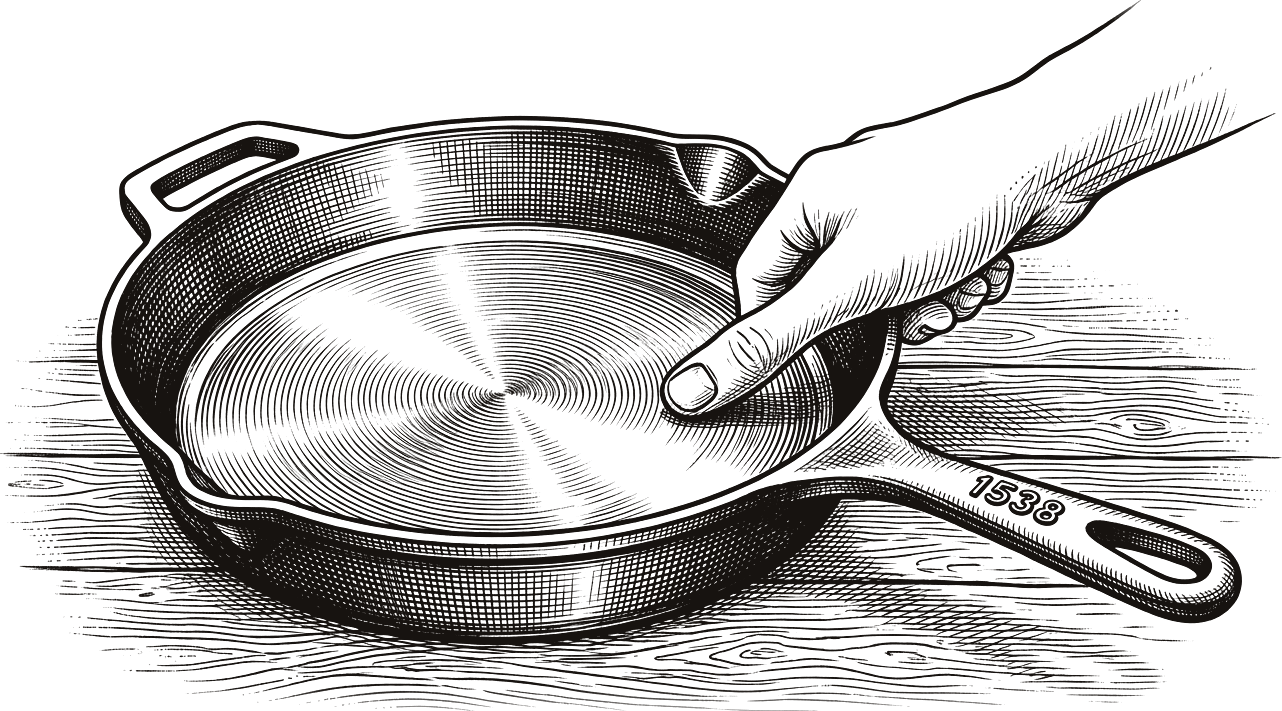
Food sticks when it bonds to the pan before a crust has formed. On cast iron that almost always comes down to three things: the pan isn’t hot enough (or is hot only in the middle), there isn’t enough fat between food and iron, or the food got moved before it was ready to release. Seasoning helps, but it isn’t a nonstick coating. Preheat longer, add fat once the pan is hot, and wait.
- Preheat on medium for at least 5 minutes. Longer on electric.
- Add fat after the pan is hot, enough to coat the bottom when you tilt it.
- Pat food dry. Wet food steams, and steamed food sticks.
- Lay it down and leave it. It lets go when the crust forms.
- Sticking in one spot only? That’s your burner, not your pan.
Read the stuck spot.
Before you change anything, look at where the food stuck. The pattern tells you what went wrong. Most guides skip this step, and it saves a lot of guessing.
Heat: hot, and hot everywhere.
Cast iron holds heat well but spreads it slowly. Iron conducts heat at roughly a quarter of the rate aluminum does, so a pan on a burner gets a hot circle over the flame and cooler edges. Turning the dial to high makes that worse, not better. The fix is time: a few minutes on medium lets the heat even out across the whole surface.

Flick a few drops of water in. If they hiss and vanish, it isn’t ready. If they ball up and skate around, the surface is hot enough to sear (roughly 400°F). For eggs, back the heat off a notch after the test.
One owner we spoke to, who’s cooked on cast iron his whole life, skips the guessing entirely: he puts the pan in a 400°F oven, then moves it to the stove. “It’s hot everywhere.” On a weak or uneven burner, it’s the most reliable trick there is.
- Dial to start
- Medium
- Preheat
- 4–5 min for a 12-inch pan
- Watch for
- A flame wider than the pan base just heats the sides and your handle. Keep it under the bottom.
- Pro move
- Rotate the pan a quarter turn halfway through preheating to even out the hot spot over the burner.
- Dial to start
- Medium (5–6 of 10)
- Preheat
- 6–8 min for a 12-inch pan
- Watch for
- Coils cycle on and off, and they change temperature slowly. Turn down a minute before you need it lower.
- Pro move
- Lift the pan a moment if it runs hot; don’t wait for the coil to catch up.
- Dial to start
- Medium
- Preheat
- 8–10 min for a 12-inch pan
- Watch for
- Slowest to heat and the most uneven. Lift, don’t slide: a rough iron base, or grit under it, can scratch the glass.
- Pro move
- Start the pan in a 400°F oven for 15 minutes, then move it to the burner. It’s hot everywhere.
- Dial to start
- Low 2 min, then medium
- Preheat
- 4–5 min for a 12-inch pan
- Watch for
- Induction heats fast and only over the coil. Full power on a cold pan stresses the iron. Settings run hot: medium is often enough to sear.
- Pro move
- Pick the zone closest to your pan’s base size, and step the power up rather than jumping to high.
- Dial to start
- Over coals, not flames
- Preheat
- 5–10 min for a 12-inch pan
- Watch for
- Flames lick up the sides and scorch the handle. Coals give steadier heat.
- Pro move
- Turn the pan every few minutes. Use the helper handle and a glove: everything gets hot.
“medium is the new high.”
— r/castiron, on induction and glass-top settings · thread
Fat: enough to cover.
Seasoning is oil baked onto the iron until it hardens. It protects the pan and gives food a smoother surface to sit on, but it isn’t Teflon. What keeps food off the iron is a layer of fat between the two.
| Cooking | Fat | How much |
|---|---|---|
| Searing steak, chops | High-heat oil (canola, avocado, grapeseed) | A thin film, about 1 tbsp |
| Eggs | Butter or oil, medium-low heat | Enough to coat the bottom when you tilt it |
| Potatoes, hash browns | Oil, more than you think | A generous layer. They drink it. |
| Fish with skin | High-heat oil | A full film; pat the skin very dry first |
Add the fat once the pan is hot. It won’t smoke while the pan heats, and it tells you when you’re ready: it shimmers. And go easy on cooking spray: it leaves a sticky film that builds up over time.
Butter starts to smoke around 350°F. If it’s browning fast, your pan’s too hot for eggs.
Timing: let it let go.
When protein first hits a hot pan, it grips. As the surface browns, it tightens and releases on its own. Pull too early and you tear it. Most sticking is a timing issue: the food just isn’t ready to let go yet.
| Food | Heat | Leave it alone for | How you know |
|---|---|---|---|
| Fried egg | Medium-low | 1–2 min | Whites set at the edges; the pan shakes it loose |
| Steak | Medium-high | 2–3 min | It slides when you nudge the pan |
| Chicken thighs, skin down | Medium | 8–12 min | Skin is deep golden and lifts cleanly |
| Fish, skin down | Medium-high | 3–4 min | Flesh turns opaque two-thirds of the way up |
| Potatoes | Medium-high | 4–5 min | Edges brown; they move as one when shaken |
And the surface?
A smoother cooking surface makes cleanup much easier and is a little more forgiving with eggs. But it changes sticking less than people think. Heat, fat and timing come first on any pan. We break it down in Smooth vs rough.
A brand-new pan does stick more for its first few weeks. Seasoning builds every time you cook with fat. Start with bacon, potatoes and sear-and-roast dinners, and save delicate eggs for week two.
“Seasoning isn’t nonstick. Must use food lube.”
— r/castiron · thread
Questions
Is it my seasoning?
Rarely. If food sticks on a pan that looks evenly black and smooth, it’s heat, fat or timing. Seasoning problems look like flaking, rust or a tacky surface; see Is My Cast Iron Ruined? Eight Symptoms and the Fix for Each
Why does steak release but eggs stick?
Steak goes into a hotter pan and forms a crust fast. Eggs cook at lower heat, have delicate proteins and set slowly, so they need more fat and more patience.
Should I preheat on high to save time?
No. High heat makes a hot spot over the burner while the edges stay cool, and it can stress the iron, especially on induction. Medium for longer gets the whole pan ready.
How long should I preheat for eggs?
About 5 minutes on medium on gas, then drop to medium-low and add butter. When the butter foams but doesn’t brown, add the egg.
Does a new pan stick more?
Usually, for the first few weeks. Cook fatty foods early on and the surface gets slicker with every meal.

The Stove Card
Preheat time and dial setting for every stove type on one fridge card, starting points until our temperature test is done. The full guide is Cast Iron on Induction, Glass-Top, Gas or Campfire: What Changes.
How we know
In October 2026 we read 824 cast iron threads and 8,226 comments on Reddit, 2,400 YouTube comments and 445 Amazon reviews. Sticking was the most common question people asked, usually as “what am I doing wrong?” Smooth vs rough drew the most debate. We also interviewed owners about how they cook. The stove-by-stove temperature test is planned, and this page will be updated with the results.